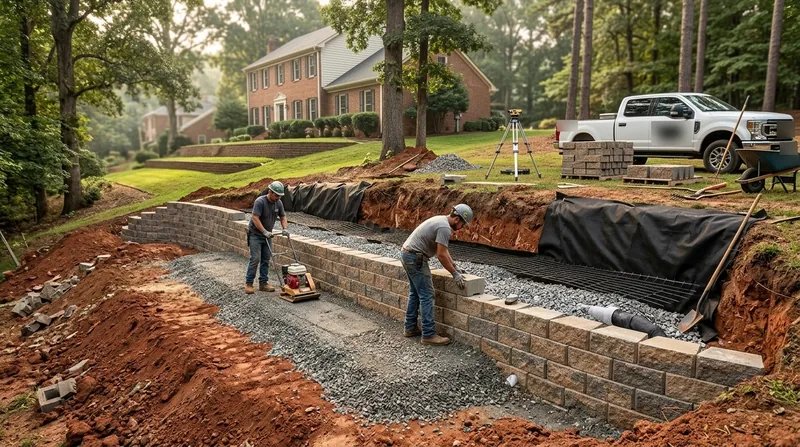




Block & Segmental Retaining Walls in Charlotte solve one of the region's most persistent landscape problems: the failure of aging timber and railroad tie walls built into Charlotte's sticky red clay. From the postwar ranches spreading east and west to the newer cut-and-fill neighborhoods behind Ballantyne and around Lake Norman, segmental retaining walls (SRW) in systems like Allan Block, Versa-Lok, and Keystone provide a modern, durable alternative to rotting timber. These engineered mortarless block walls with geogrid reinforcement handle Charlotte's brutal seasonal swings, where summer thunderstorms and tropical-storm rain soak clay soil, and drought shrinks it back. Whether you need a new tiered garden wall in Dilworth, a tall terraced wall behind a new deck in Myers Park, or a curved landscape feature in NoDa, segmental walls deliver strength, flexibility, and a finished look that lasts decades. We install, repair, and replace these walls throughout Charlotte and the surrounding area. Call us at (980) 414-6473 for a free estimate, or learn more about retaining wall installation to see how we approach your specific site.
Why Segmental Block Walls Fail in Charlotte, and How to Fix Them
Charlotte's landscape is built on rolling upland terrain cut by creek valleys like Sugar, Briar, and McAlpine Creek. The underlying red clay and weathered saprolite absorb water like a sponge during heavy rain, then shrink dramatically during drought. Older timber and railroad tie walls, which dominated residential construction through the 1990s, have no internal drainage and no reinforcement to handle the lateral pressure that builds when clay becomes saturated. The result: leaning walls, bulging sections, and complete failure. Segmental block walls solve this problem by design, using a permeable gravel backfill and geogrid layers that distribute pressure and allow water to drain safely.
- Segmental walls use open-jointed block that allows water to percolate through the face, not pond behind it like timber walls do.
- Geogrid reinforcement layers tie the wall together and extend back into the retained soil, anchoring the structure and preventing rotation or bulging.
- Proper drainage fabric and gravel behind the wall manage the seasonal clay movement that destroys unreinforced walls in Charlotte.
- Curved and tiered layouts are possible with segmental systems, giving you design flexibility that railroad ties cannot match.
- These walls carry a 20 to 50-year lifespan when installed correctly, compared to 10 to 15 years for rotting timber in Charlotte's humid climate.
Understanding the failure mode specific to Charlotte's clay and rainfall patterns is critical when choosing a contractor and material. Segmental walls address the real problem, not just the surface symptom.
Key info: Many jurisdictions in Charlotte, Concord, Gastonia, and Huntersville require a permit for walls taller than roughly 4 feet measured from the footing, or when a wall supports a surcharge such as a driveway or deck. Engineered drawings are often required for walls over 4 feet or tiered designs. Always verify setback and property-line rules with your local building department before starting work, as thresholds vary by municipality. See the City of Charlotte Building Permits and Code Enforcement for current requirements.
How We Install and Repair Block & Segmental Retaining Walls in Charlotte
A properly installed segmental wall begins with site assessment, drainage planning, and a solid foundation. We inspect your existing soil, slope angle, and any structures or utilities nearby. For new installations, we establish a level gravel footing below the frost line, set the first course of block level and straight, then build upward, adding geogrid every two to three courses and backfilling with clean drainage rock. For repairs to leaning or failed walls, we often remove the compromised section, rebuild the foundation, and reinstall with reinforcement. The key is getting the drainage right: without it, even a new wall will fail in Charlotte's climate.
- We excavate and prepare a level, compacted gravel footing below the frost line to prevent frost heave and settling.
- We set the first course of block square and level, checking alignment frequently as we build upward.
- We install geogrid reinforcement layers every two to three block courses, extending the grid back into the retained soil for maximum stability.
- We backfill behind the wall with clean, free-draining gravel and install drainage fabric to separate gravel from native soil and prevent clay from clogging the system.
- We cap the wall with finishing block and grade the area to shed surface water away from the wall face.
- For leaning or failed walls, we carefully remove the damaged section, assess the foundation, rebuild, and reinforce, then tie the new section to any remaining stable wall.
Each step is site-specific; a steep slope in Eastover requires different reinforcement than a gentle rise in a Matthews subdivision, and we adjust our approach accordingly.
Example: A homeowner in Plaza Midwood had a 1910s-era brick garden wall that was cracking and leaning inward. Rather than demolish the historic brick, we built a new segmental wall behind it, reinforced with geogrid, and used it to support the slope while the brick remains as a visible garden feature. The new wall handles all the soil pressure; the brick stays put as part of the landscape character.
For more on how we approach repair work, see our page on leaning and collapsed wall repair.
Methods and Materials for Block & Segmental Retaining Walls
| Approach | Description | Best for |
|---|---|---|
| Allan Block SRW | Interlocking mortarless block with a natural stone face, available in multiple colors and textures. Blocks are set with a slight backward lean (batter) to improve stability. | Residential garden walls, landscape terraces, curved designs, and mid-height walls (up to 12 feet with proper reinforcement). |
| Versa-Lok SRW | Segmental blocks with a unique tapered design and integral drainage. Connects with pins rather than relying on friction alone, allowing taller, steeper walls and easier repair. | Tall walls (over 12 feet), steep slopes, and commercial applications where structural reliability and longevity are paramount. |
| Keystone SRW | Modular blocks with a trapezoidal cross-section that creates a natural batter. Available in various colors and finishes. Lightweight and easy to handle on tight sites. | Residential retrofit projects, HOA-compliant landscape walls, and properties where access is limited and equipment must be minimal. |
| Geogrid Reinforcement | Synthetic polymer grids installed horizontally between block courses. They distribute lateral soil pressure and prevent sliding or rotation of the wall mass. | All segmental walls over 4 feet, any wall with a surcharge (driveway, structure), and any slope where clay saturation is a concern (which is all of Charlotte). |
We select the right system based on your wall height, slope angle, soil conditions, design preferences, and local permit requirements. Taller walls and steeper slopes demand more robust reinforcement and often require engineered drawings.
Block & Segmental Retaining Walls Cost in Charlotte: What to Expect
Segmental retaining wall installation in Charlotte typically starts at $25 per square foot for straightforward, single-height walls in standard materials like Keystone or Allan Block. Costs rise with wall height, reinforcement complexity, site access, and soil conditions. A 4-foot-tall wall running 30 feet long might cost $3,000 to $5,000 installed. A 10-foot tall or tiered wall in a difficult site with poor access, heavy clay, or existing failed wall removal can easily reach $10,000 to $20,000 or more. Repair work on an existing leaning wall often costs less than full replacement if the foundation is sound, but removal and disposal of failed timber can add significant cost.
Several factors move the price up or down: wall height and length, number of tiers or curves, depth of geogrid reinforcement required, existing wall removal and disposal, site access and equipment constraints, soil preparation and drainage needs, and local permit and engineering fees. A free on-site estimate is the only reliable way to get an accurate number for your project. We respond within 24 hours and provide a detailed breakdown of materials, labor, and any contingencies.
For a detailed pricing guide and examples of recent jobs, visit our full pricing overview. Call (980) 414-6473 to schedule your free estimate.
Block & Segmental Retaining Walls Near Me: What Charlotte Homeowners Should Know When Hiring a Contractor
Not all contractors who install retaining walls understand the specific challenges of Charlotte's clay soil, seasonal moisture swings, and drainage requirements. When hiring a contractor for block or segmental wall work, verify that they are licensed and insured, have references you can contact, and understand the permit and engineering requirements for your wall height and site. Ask to see examples of completed walls in Charlotte, Concord, Gastonia, or nearby areas. Confirm they pull permits and work with local building departments rather than trying to avoid them. For walls over 4 feet or in HOA-controlled properties, confirm that your contractor can obtain or work with an engineer to produce drawings that satisfy your local jurisdiction.
- Verify that the contractor holds a current general contractor license and carries liability and workers compensation insurance in North Carolina.
- Request at least three references from homeowners in Charlotte or the surrounding area whose walls were installed or repaired in the past three years.
- Ask how the contractor handles drainage design and whether they include a site-specific drainage plan in their estimate.
- Confirm that the contractor will obtain any required permits and work with the local building department, rather than advising you to skip permitting.
- If your wall is in an HOA community, verify that the contractor understands HOA approval timelines and material restrictions.
- Get estimates from at least two or three contractors before committing, so you can compare scope, materials, timeline, and price.
A contractor who takes time to assess your site, explain the drainage strategy, and discuss permit requirements is one who understands the real work. Contact us at Charlotte Retaining Wall for a free, no-obligation estimate and a candid conversation about your wall.
Block & Segmental Retaining Walls in Charlotte: Pricing Guide
| Service | Price | Details |
|---|---|---|
| Single-height segmental wall (4 feet or less) | Starting at $25/sq ft | Includes standard block, geogrid, gravel backfill, and drainage fabric for straightforward installations with good site access |
| Tall or tiered segmental wall (5 to 10 feet) | Starting at $35/sq ft | Includes additional geogrid reinforcement layers, engineered design, and more complex drainage; higher cost reflects structural demands |
| Leaning or failed wall repair | On estimate | Removal of failed section, foundation assessment, and rebuilding with reinforcement; cost depends on wall height, length, and foundation condition |
| Curved or specialty design walls | On estimate | Custom layouts, multiple tiers, or architectural finishes require site-specific engineering and material selection; on-site consultation required |
| Travel and site visit | Included | No separate mileage fee or travel charge within Charlotte and surrounding service areas; estimate included in project quote |
| Free estimate | No charge | On-site assessment, materials review, and detailed quote provided within 24 hours at (980) 414-6473, no obligation to book |
Indicative pricing, the exact cost depends on square footage, finish, and site access. Free personalized estimate within 24h at (980) 414-6473.


