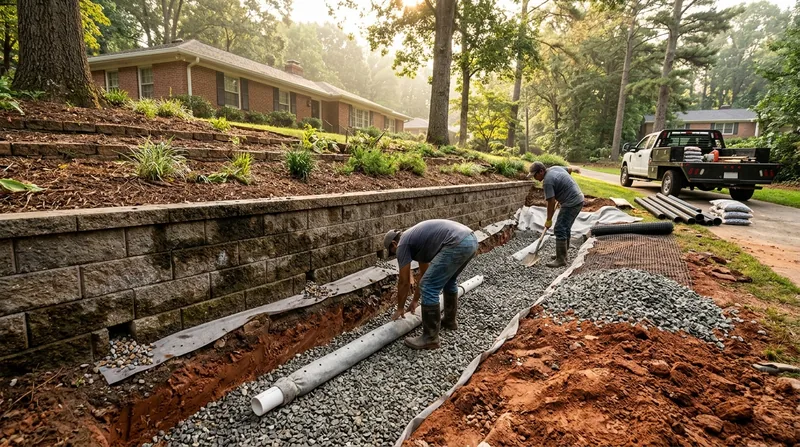




Retaining wall drainage in Charlotte is not optional, it is the difference between a wall that lasts 20 years and one that fails in five. Charlotte sits on dense red clay over weathered saprolite, and that clay absorbs water from summer thunderstorms and tropical system rainfall with nowhere to go. When hydrostatic pressure builds up behind a wall with no drainage, the soil pushes harder and harder until the wall leans, cracks, or collapses entirely. We install French drains, weep holes, gravel backfill, and waterproofing systems that move water away from your wall and keep it standing. If you already have a failing wall, we repair it and add drainage to prevent the same failure from happening again. Call us at (980) 414-6473 for a free estimate, or learn more about our retaining wall repair services.
Why Retaining Wall Drainage Fails So Fast in Charlotte's Clay Soil
Charlotte's red clay is sticky and impermeable. Rain that falls on or behind your retaining wall does not drain naturally; it soaks into the clay and stays there. As the clay becomes saturated, it expands and pushes sideways with enormous force. At the same time, seasonal drought causes the clay to shrink, which opens cracks in the soil and allows water to penetrate even deeper. This wet-dry cycle, repeated year after year, is the primary reason retaining walls fail in this region. Neighborhoods from Myers Park to Ballantyne, from NoDa to the Lake Norman shoreline, all face the same problem: walls without proper drainage systems will eventually fail.
- Hydrostatic pressure from saturated clay pushes walls outward and causes them to lean or tip.
- Water trapped behind a wall freezes in rare cold snaps, expanding and cracking the wall structure.
- Erosion of the soil behind the wall weakens the foundation and allows settlement and tilting.
- Drainage systems relieve this pressure and add 15 to 20 years or more to the life of your wall.
Without drainage, even a well-built wall is fighting a losing battle against Charlotte's climate and soil.
Key info: The 1980s and 1990s subdivisions across Charlotte are full of rotting landscape timber and railroad tie walls that were built without drainage. Most of these walls are now failing. Segmental block walls in newer cut-and-fill neighborhoods from Ballantyne to the Lake Norman shoreline also fail quickly without proper drainage behind them. See our railroad tie wall replacement service for details on fixing these common failures.
For more information on local regulations and permitting, the Charlotte Building Code Enforcement office provides guidance on wall height thresholds and drainage requirements for your property.
How We Install Retaining Wall Drainage in Charlotte
Our drainage approach is straightforward: we move water away from your wall as quickly as possible. We excavate behind the wall or along its base, install a perforated drain pipe in gravel, and slope it downhill or to a daylight outlet where water can escape. We also drill weep holes through the wall itself to allow water pressure to release. Finally, we backfill with free-draining stone instead of clay, so water moves through the backfill rather than pooling behind the wall. Every step is designed to keep hydrostatic pressure low and your wall stable.
- We assess the existing wall, soil conditions, and water flow patterns on your property.
- We excavate a trench behind or at the base of the wall, removing clay and debris.
- We install a perforated drain pipe in a gravel bed, sloped to daylight or a sump location.
- We drill weep holes (typically 4 inches diameter) through the wall at regular intervals to release pressure.
- We backfill the trench with clean stone and landscape fabric to prevent clay from clogging the drain.
- We verify drainage flow and make adjustments to ensure water moves away from the wall structure.
The result is a wall that stays dry, stays stable, and serves your property for decades.
Local example: A Dilworth homeowner had a 1920s brick garden wall that was cracking and leaning inward. We excavated behind it, installed a French drain sloped toward the street, added weep holes, and backfilled with stone. The wall stopped moving within weeks. Two years later, it remains stable. That same wall would have collapsed within another season if we had simply patched the cracks without addressing drainage. See our retaining wall installation page for more on building walls that last.
Retaining Wall Drainage Methods and Materials
| Approach | Description | Best for |
|---|---|---|
| French Drain (Subsurface) | Perforated pipe buried in gravel behind or at the base of the wall, sloped to daylight or a sump. Collects and moves water away from the wall structure continuously. | Most retaining walls in Charlotte, especially those with high water tables or poor drainage behind them. |
| Weep Holes | 4-inch holes drilled through the wall face at regular intervals (typically 8 to 12 feet apart) to allow water to escape and pressure to release. Often paired with a French drain for best results. | Existing walls that cannot be excavated behind, or as a secondary relief system in new installations. |
| Gravel Backfill and Fabric | Clean, free-draining stone (typically 3/4-inch to 1.5-inch) placed behind the wall with landscape fabric to prevent clay migration. Water moves through stone instead of pooling in clay. | New wall installations and full-drainage overhauls where the soil behind the wall can be removed and replaced. |
| Waterproofing Membrane | Rubber or polymer sheet applied to the back face of the wall to block water infiltration and direct it toward drain outlets. Often used on concrete or block walls. | Concrete retaining walls and block walls where water is seeping through the wall face itself, not just pooling behind it. |
| Sump and Pump System | A collection pit at the base or low point of the wall with a submersible pump that moves water away from the property. Used when daylight drainage is not possible due to site constraints. | Properties in low-lying areas, urban lots, or situations where water cannot flow downhill away from the wall. |
Each method is chosen based on the wall type, soil conditions, water volume, and site layout. We often combine two or more methods for maximum protection.
Retaining Wall Drainage Cost in Charlotte: What to Expect
Retaining wall drainage work in Charlotte typically starts at $2,500 for a small to medium wall with a straightforward French drain installation. The cost depends on several factors: the length and height of the wall, how much excavation is needed, whether the wall is already in place or being built new, soil type and water conditions, accessibility for equipment, and whether a daylight outlet is available or a sump pump is required. A 30-foot wall with a 4-foot height and good access might fall in the $2,500 to $4,500 range. A taller wall, a longer run, difficult terrain, or the need for a pump system can push the cost higher. We always provide a free, no-obligation estimate on site so you know exactly what you are paying for and why.
The best way to understand pricing for your specific wall is to get two or three estimates from licensed contractors. Compare not just the price but the methods proposed, the materials specified, and the warranty offered. A drainage system is an investment that adds years to the life of your wall and prevents costly repairs down the road. Visit our pricing page for more detail on how we structure costs and what is included at each level.
Retaining Wall Drainage Near Me: What Charlotte Homeowners Should Know When Hiring
Hiring a contractor for retaining wall drainage is a big decision. You want someone who understands Charlotte's clay soil, knows the local building codes, and has the equipment and skill to install a system that actually works. Start by asking any contractor for proof of licensing and current liability insurance. Verify their license with the North Carolina General Contractor's Board. Ask for references from recent projects in Charlotte or nearby areas, and call those references to ask about quality, timeliness, and whether the drainage system is still working years later. Get at least two estimates in writing so you can compare methods and materials. If your wall is near a property line or if your neighborhood has an HOA, check the rules before digging; some associations require approval for drainage work or have setback restrictions. Finally, understand that some walls above 4 feet in height, or walls that support a surcharge such as a driveway or deck, may require a permit from your local building department. Always defer to your city or county building inspector; thresholds vary by jurisdiction.
- Verify the contractor is licensed and insured in North Carolina and carries general liability coverage.
- Ask for at least three recent references from similar drainage or wall projects in Charlotte.
- Get written estimates from at least two contractors so you can compare methods, timeline, and price.
- Check with your local building department to confirm whether a permit is required for your wall height and type.
- If you live in an HOA community, review your covenants and get written approval before work begins.
- Ask the contractor about their warranty on the drainage system and what maintenance (if any) you will need to do.
A qualified contractor will answer your questions clearly, show you exactly what they plan to do, and stand behind their work. Contact us for a free estimate, or call (980) 414-6473 if you have questions about your wall or drainage needs.
Retaining Wall Drainage in Charlotte: Pricing Guide
| Service | Price | Details |
|---|---|---|
| Small wall drainage (under 20 feet long, 3 to 4 feet high) | Starting at $2,500 | French drain with weep holes, gravel backfill, and stone outlet. Includes excavation, pipe, and labor for straightforward access. |
| Medium wall drainage (20 to 50 feet long, 4 to 6 feet high) | Starting at $3,500 | Full French drain system with multiple weep holes, landscape fabric, and daylight outlet. Cost increases with wall length, height, and soil removal complexity. |
| Large or complex drainage system (over 50 feet, 6+ feet high, difficult access, or sump pump required) | On estimate | Site-specific assessment required. Factors include equipment access, soil type, water volume, and whether pump or extensive regrading is needed. |
| Waterproofing membrane (concrete or block wall face) | Starting at $1,500 | Applied to wall surface to block infiltration and direct water to drain outlets. Often combined with French drain for maximum protection. |
| Travel and mobilization | Included | No separate charge for travel within Charlotte and surrounding service areas. Equipment and crew dispatch included in project estimate. |
| Free estimate | No charge | On-site assessment with timeline and detailed proposal. Response within 24 hours at (980) 414-6473. No obligation to book. |
Indicative pricing, the exact cost depends on square footage, finish, and site access. Free personalized estimate within 24h at (980) 414-6473.


