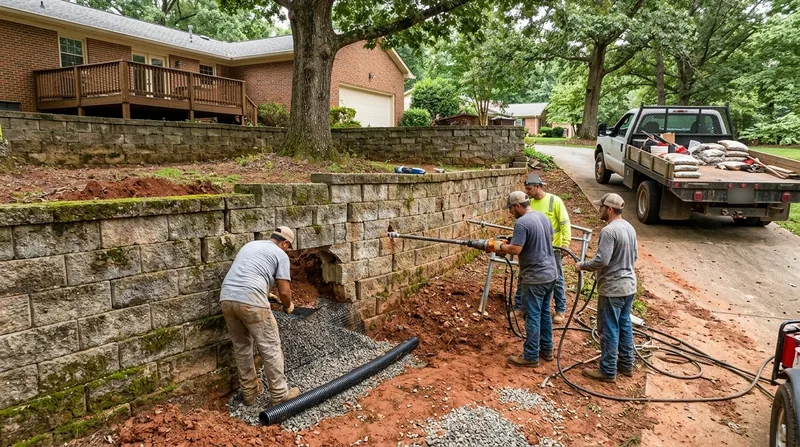




Retaining Wall Repair in Charlotte stops the slow collapse of walls that are leaning, cracking, or settling into the red clay slopes that define this city's terrain. Charlotte sits on sticky, moisture-hungry clay over weathered saprolite, cut by creek valleys like Sugar, Briar, and McAlpine Creek. When summer thunderstorms and tropical-storm rain soak the ground behind a wall with no drainage, the clay swells; when drought hits, it shrinks. Walls bow inward, cracks open, and soil spills forward. The neighborhoods hit hardest are the 1980s and 1990s subdivisions full of rotting landscape timber and railroad tie walls, and the newer cut-and-fill developments from Ballantyne to Lake Norman shoreline that rely on tall segmental block walls behind backyards. We repair these walls before they fail completely, using drainage correction, tieback anchors, and partial rebuilds to stabilize the slope and save your yard.
Why Retaining Wall Repair Matters on Charlotte's Rolling Clay Terrain
A failing retaining wall is not cosmetic. When a wall leans or bows, it signals that the soil pressure and moisture behind it have overwhelmed the structure. In Charlotte, this happens because our clay soils absorb water like a sponge during heavy rain, then shrink during dry spells, creating massive stress on the wall face. A wall that moves now will move faster later. Ignoring it means eventual collapse, which can damage your home's foundation, bury a driveway, or send soil into a neighbor's property. Early repair stops the failure mode and restores stability to your slope.
- We identify the root cause of failure, whether it is poor drainage, settlement, or inadequate wall height and footing depth.
- We install or improve drainage systems behind the wall to reduce hydrostatic pressure and clay saturation.
- We use tieback anchors, soil nails, or partial rebuilds to lock the wall back into stable position.
- We verify compliance with local building codes and obtain permits where required by your jurisdiction.
Catching a failing wall early keeps repair costs down and prevents catastrophic collapse that would require full replacement.
Key info: Many Charlotte neighborhoods built in the 1990s on clay slopes are seeing timber and segmental block walls fail now, 25 to 30 years after installation. Homeowners in Myers Park, Eastover, Dilworth, NoDa, and Ballantyne often find walls leaning or cracking after heavy rain or drought cycles. We have repaired hundreds of these walls and know the failure patterns on every slope in the metro area.
For more information on the full scope of wall issues we address, see our page on Leaning and Collapsed Wall Repair.
The North Carolina Licensing Board for General Contractors maintains a searchable database of licensed firms; you can verify our standing at nclbgc.org.
How We Repair Retaining Walls on Charlotte Slopes: Our Process
Every wall repair in Charlotte starts with a site inspection. We walk the slope, examine the wall face and footing, probe the soil and drainage behind it, and assess what has caused the movement. We then recommend the repair method that fits the failure mode, your budget, and the wall's remaining life. Some walls need only drainage work; others need anchors or a partial rebuild. We always pull permits where your local building department requires them.
- We schedule a free site visit to assess the wall, soil conditions, and drainage status.
- We provide a detailed estimate that explains the failure cause and the repair approach.
- We obtain any required permits from your city or county building department before work begins.
- We install drainage, anchors, or rebuild sections as specified, working carefully around trees, utilities, and nearby structures.
- We backfill and compact, then grade and seed or mulch the slope to prevent erosion.
- We perform a final inspection and walk you through the work and any ongoing maintenance.
The entire process, from inspection to completion, is transparent and keeps you informed at every step.
Example: A homeowner in Huntersville noticed their segmental block wall leaning inward after a wet spring. We inspected and found zero drainage behind the wall and a shallow footing on clay. We installed a perforated drain line at the wall base, backfilled with gravel, and installed two soil nail anchors to lock the wall back. The work took five days, required a permit from the town, and cost $4,200. The wall is now stable and the homeowner has a 20-year warranty on the repair.
For more detail on drainage solutions, visit our Retaining Wall Drainage page.
Retaining Wall Repair Methods and Materials
| Repair Approach | Description | Best For |
|---|---|---|
| Drainage Installation | Install perforated drain pipe at the base of the wall, backfill with gravel, and direct water away from the footing. Often paired with a surface swale or French drain on the slope above. | Walls leaning or weeping water due to poor drainage behind them. Most common repair in Charlotte. |
| Soil Nail Anchors | Drive steel nails or helical anchors through the wall face into stable soil behind it, then tension them to lock the wall in place and resist future movement. | Walls leaning 2 to 6 inches inward, or walls with adequate footing but failing face. Minimal excavation required. |
| Tieback Anchors | Install long steel cables or rods anchored deep into stable soil or bedrock, then tension them to pull the wall back into plumb and resist lateral pressure. | Tall walls or walls with heavy surcharge (driveway, structure). Works on clay and saprolite slopes common in Charlotte. |
| Partial Rebuild | Remove the failed section of wall, correct the footing and drainage, and rebuild using the original material or segmental block, stone, or poured concrete. | Walls with structural damage, settlement, or inadequate original construction. Common for failed timber and railroad tie walls. |
| Retaining Wall Replacement | Demo and rebuild the entire wall with modern materials, engineered footing, and drainage. Often the best long-term solution for walls over 25 years old. | Walls beyond repair, or when a homeowner wants to upgrade to a new material or taller wall. See our Retaining Wall Replacement service for details. |
The method we recommend depends on the wall's age, material, degree of movement, soil conditions, and your budget. We always present all viable options at your free estimate.
Retaining Wall Repair Cost in Charlotte: What to Expect
Repair costs in Charlotte range from $1,500 for drainage work on a short wall to $8,000 or more for tieback anchors or a partial rebuild. The main factors that move the price are the wall's height and length, the degree of movement or damage, soil access and conditions, whether permits are required, and whether you need engineered drawings from a structural engineer. A simple drainage repair on a 20-foot wall might cost $2,000 to $3,500. Soil nail anchors or tieback anchors on a taller or more severely leaning wall run $5,000 to $10,000. A partial rebuild of a failed section can run $6,000 to $15,000 depending on the wall height and material.
We always provide a free, no-obligation estimate after a site visit. We recommend getting 2 to 3 estimates from licensed contractors to understand the scope and compare approaches. Some contractors will offer a quick phone quote; we don't, because every wall is different and a proper estimate requires an in-person inspection.
For a full pricing breakdown and examples of common repair jobs, see our Pricing page.
Retaining Wall Repair Near Me: What Charlotte Homeowners Should Know When Hiring a Contractor
Choosing the right contractor for retaining wall repair is critical. You want someone who understands Charlotte's clay soils, has done this work for years, and will pull the proper permits. Start by verifying that any contractor you call is licensed and insured. Ask for references from recent jobs in your neighborhood or similar terrain. Understand whether the contractor will handle permitting or if you need to pull it yourself (we always handle it). If your wall is tall or has a heavy surcharge such as a driveway or structure, confirm that the contractor will have an engineer design the repair. Finally, make sure you get everything in writing: the scope of work, the method, the timeline, and the warranty.
- Ask for at least three references from homeowners in Charlotte, Concord, Gastonia, or nearby areas where the contractor has done similar repairs.
- Confirm whether the contractor will obtain permits or if you are responsible for pulling them from your city or county building department.
- Request a written estimate that details the repair method, materials, timeline, and warranty or guarantee on the work.
- Ask whether the contractor has experience with your wall's specific material, whether it is timber, railroad tie, segmental block, poured concrete, or natural stone.
- Understand the payment terms: deposits, progress payments, and final payment upon completion and inspection.
A reputable contractor will answer all these questions without hesitation and will never pressure you into an immediate decision.
When you are ready to move forward, contact us for a free estimate. We serve Charlotte, Concord, Gastonia, Huntersville, Matthews, Mint Hill, Cornelius, Davidson, and surrounding areas. Call (980) 414-6473 or fill out our online form for a response within 24 hours.
Retaining Wall Repair in Charlotte: Pricing Guide
| Service | Price | Details |
|---|---|---|
| Drainage Repair or Installation | Starting at $1,500 | Perforated drain line, gravel backfill, and surface grading for walls leaning due to water pressure behind them |
| Soil Nail or Tieback Anchor Repair | Starting at $4,500 | Installation of steel anchors tensioned to lock a leaning wall back into plumb, price varies with wall height and number of anchors |
| Partial Wall Rebuild | Starting at $6,000 | Removal and reconstruction of a failed wall section, new footing, drainage, and backfill, cost scales with height and length of section |
| Full Wall Replacement | Starting at $10,000 | Complete demo and rebuild with modern material and engineered design, cost depends on wall height, length, and material choice |
| Site Inspection and Estimate | Free | No-obligation visit to assess the wall, identify the failure mode, and provide a detailed repair plan and pricing in writing |
Indicative pricing, the exact cost depends on square footage, finish, and site access. Free personalized estimate within 24h at (980) 414-6473.


