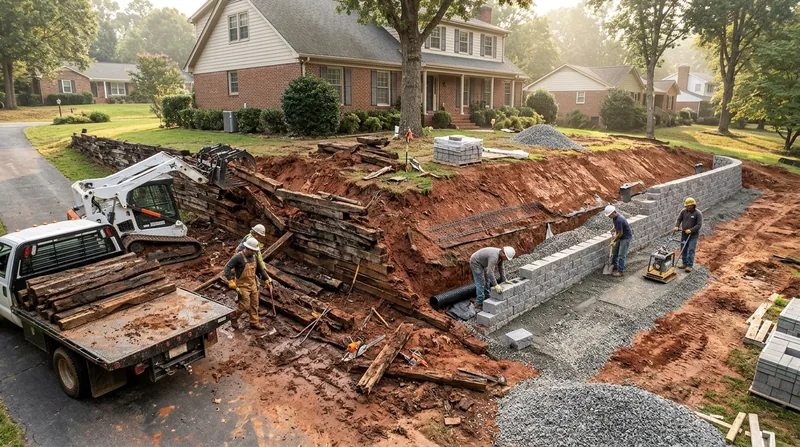




Railroad Tie Wall Replacement in Charlotte is one of the most common retaining wall jobs we handle, especially across the 1980s and 1990s subdivisions that ring the city. Thousands of Charlotte homes sit on lots graded and held back by creosote-treated railroad ties and landscape timbers, and after 30 to 40 years of exposure to our sticky red clay, summer thunderstorms, and drought cycles, these walls fail. The ties rot from the inside out, lean inward, or collapse entirely, leaving soil unstable and drainage compromised. We remove the old ties, haul away the creosote-treated material responsibly, rebuild the wall in segmental block, poured concrete, or natural stone, and install proper backfill and drainage so the wall lasts another generation. This page walks you through why the job matters, how we do it, what it costs, and what to look for when hiring a contractor.
Why Railroad Tie Wall Replacement Matters in Charlotte
Charlotte's landscape is defined by rolling upland terrain cut by creek valleys like Sugar, Briar, and McAlpine. Most residential lots require some form of grading and retaining, and the postwar ranches, 1980s subdivisions, and newer cut-and-fill neighborhoods all rely on walls to hold soil in place. Railroad ties were cheap and easy to install 40 years ago, but they were never engineered for Charlotte's specific climate challenge: our red clay soaks up summer thunderstorm and tropical-storm rain like a sponge, then shrinks dramatically during drought. Without proper drainage behind the wall, that hydrostatic pressure builds, the ties rot from moisture and creosote breakdown, and the wall leans or fails.
- Rotting ties lose structural integrity and begin to bow inward or collapse, destabilizing the soil above.
- Creosote-treated wood requires safe removal and disposal, not just demolition and burial.
- Failed walls allow erosion, undermine driveways and patios, and create liability if soil or debris enters a neighbor's property.
- A new wall with proper drainage and modern materials protects your investment and prevents future slope failure.
Replacing a failed railroad tie wall stops ongoing erosion, restores usable yard space, and gives you a wall that will hold for decades.
Key info: Charlotte and surrounding areas including Matthews, Mint Hill, and Huntersville are full of 1980s and 1990s subdivisions with rotting railroad tie walls. The clay-rich soil and heavy summer rain are the primary culprits. If your wall leans, shows gaps, or has visible rot, replacement is usually the best long-term solution. Contact us for a free assessment at (980) 414-6473.
For more on the full range of wall repairs and replacements, see our Retaining Wall Replacement page, which covers all material types and failure scenarios.
North Carolina's Department of Insurance regulates contractor licensing and bonding. You can verify a contractor's license at the North Carolina Department of Insurance website before you hire.
How We Replace Railroad Tie Walls in Charlotte: Our Process
Railroad tie wall replacement is a multi-step process that starts with careful demolition and ends with a stable, properly drained wall built to last. We handle the creosote-treated material responsibly, prepare the site for a new wall, and choose the best material for your lot, budget, and aesthetic. Every job is site-specific because Charlotte's terrain, drainage patterns, and neighborhood character vary widely. A wall in Myers Park or Eastover might call for natural stone or brick to match the historic character of those neighborhoods, while a postwar ranch in East Charlotte might benefit from segmental block for durability and low maintenance.
- We inspect the failed wall, assess soil conditions, and identify drainage issues or surcharge loads like driveways or structures.
- We obtain any required permits from your local building department, which typically applies if the wall exceeds 4 feet measured from the footing.
- We remove and haul away all creosote-treated ties and old material according to environmental and disposal standards.
- We excavate and prepare the base, compact soil, and set up proper drainage (typically perforated pipe and gravel backfill).
- We build the new wall in your chosen material: segmental block, poured concrete, or natural stone.
- We backfill with clean gravel, install drainage fabric, and compact in lifts to ensure stability and water flow.
The entire process typically takes 2 to 4 weeks depending on wall height, length, and material choice. See our Retaining Wall Drainage page for more detail on how proper drainage prevents future failure.
Local example: A 35-foot-long, 3-foot-tall railroad tie wall in Cornelius that had begun to lean inward after heavy rain. We removed the ties, discovered poor drainage and clay saturation behind the wall, installed a perforated drain line, and rebuilt in segmental block with proper backfill. The new wall is level, well-drained, and will serve the homeowner for 30+ years.
Replacement Methods and Materials
We offer three primary approaches to railroad tie wall replacement, each with distinct advantages for different lots, budgets, and aesthetic goals. Your choice depends on the wall's height, length, soil type, drainage conditions, and how the wall fits into your home's landscape and neighborhood character. We help you weigh the trade-offs during the free estimate.
| Approach | Description | Best for |
|---|---|---|
| Segmental Block (SRW) | Modular retaining wall units stacked and locked together, with geogrid reinforcement for walls over 4 feet. Durable, low-maintenance, and available in multiple colors and textures. | Most residential replacements in Charlotte. Fast installation, long lifespan, clean modern or traditional look. |
| Poured Concrete | A solid concrete wall cast on-site or precast panels bolted together. Monolithic, extremely strong, and suitable for tall or heavily loaded walls. | Walls above 6 feet, driveways or structures bearing on the wall, or where a seamless appearance is desired. |
| Natural Stone or Boulder | Fieldstone, stacked rock, or large boulders mortared or dry-laid. High aesthetic value, fits historic neighborhoods like Myers Park and Eastover. | Shorter walls in upscale neighborhoods where character and curb appeal matter. More labor-intensive and costly than block. |
| Timber Replacement (Hardwood) | New landscape timbers or railroad ties treated with modern, less-toxic preservatives, or untreated hardwood. A like-for-like approach if the original aesthetic is preferred. | Homeowners who want the original timber look and are willing to accept eventual maintenance or replacement in 15 to 25 years. |
Each material has a different cost, lifespan, and maintenance profile. We discuss all options during your free estimate so you can make an informed choice.
Railroad Tie Wall Replacement Cost in Charlotte: What to Expect
Railroad tie wall replacement in Charlotte typically starts at $35 per square foot for segmental block walls in good soil conditions with straightforward access and drainage. A 30-foot-long, 3-foot-tall wall (90 square feet) would run roughly $3,150 to $4,500 depending on site prep, drainage complexity, and whether permits are required. Poured concrete runs higher, $50 to $75 per square foot, while natural stone or boulder walls can exceed $100 per square foot because of the labor-intensive installation and material cost. Factors that move pricing up include wall height over 4 feet, poor soil or unstable grades that require extra base prep, heavy clay that needs aggressive drainage, proximity to structures or utilities, difficult site access, and material choice.
The best way to get an accurate price is to schedule a free, no-obligation estimate. We visit your site, assess the failed wall, check soil and drainage conditions, and discuss material options. You get a detailed written quote with a timeline. We always recommend getting 2 to 3 estimates from licensed contractors so you can compare scope, materials, and price. See our full pricing page for more detail on what drives costs and what's included in our estimates.
Call us at (980) 414-6473 or request a free estimate online. We respond within 24 hours and can often schedule a site visit within a few days.
Railroad Tie Wall Replacement Near Me: What to Look for When Hiring a Contractor in Charlotte
Choosing the right contractor for railroad tie wall replacement is as important as the materials you select. A poorly executed job can fail again in a few years, waste your money, and create liability. Look for a contractor who is licensed and insured in North Carolina, has verifiable references from local jobs, understands Charlotte's soil and drainage challenges, and can walk you through permitting and material options without pressure. Ask to see examples of past work in your neighborhood or similar terrain. A good contractor will ask detailed questions about your goals, site conditions, and budget before quoting, not just give you a number over the phone.
- Verify that the contractor holds a valid North Carolina general contracting or specialty license and carries liability and workers compensation insurance.
- Ask for at least three local references and follow up with homeowners to ask about quality, timeline, and how the wall has held up since completion.
- Check whether the contractor understands local permitting rules, which vary by jurisdiction and may require engineered drawings for walls over 4 feet or near property lines.
- Confirm that the contractor has experience with creosote-treated material disposal and knows how to handle it safely and legally in North Carolina.
- Ask about drainage design and whether the contractor uses perforated pipe, gravel backfill, and drainage fabric as standard practice in Charlotte's clay soils.
- Get everything in writing: scope, materials, timeline, payment schedule, and warranty or guarantee terms.
A contractor who takes time to understand your site and your goals, provides a detailed estimate, and stands behind the work is worth the wait and the call. Contact us today for a free estimate and to discuss your railroad tie wall replacement project.
Railroad Tie Wall Replacement in Charlotte: Pricing Guide
| Service | Price | Details |
|---|---|---|
| Segmental Block Wall Replacement | Starting at $35/sq ft | Modular block wall with proper drainage and backfill, includes site prep, excavation, and compaction in Charlotte clay soils |
| Poured Concrete Wall Replacement | Starting at $50/sq ft | Monolithic concrete wall cast on-site or precast panels, suitable for walls over 6 feet or heavily loaded conditions |
| Natural Stone or Boulder Wall Replacement | Starting at $80/sq ft | Fieldstone or stacked boulder wall, labor-intensive installation, high aesthetic value for historic neighborhoods like Myers Park |
| Timber Replacement (Landscape or Railroad Ties) | Starting at $25/sq ft | New treated or untreated timber wall, like-for-like replacement, lower initial cost but shorter lifespan than block or concrete |
| Complex or Large-Scale Job | On estimate | Walls over 8 feet, tiered systems, poor drainage or unstable soil, proximity to structures, or multiple drainage challenges require site evaluation |
| Free Estimate and Site Visit | No cost | Response within 24 hours, detailed assessment of soil and drainage, material options discussed, written quote with timeline provided |
Indicative pricing, the exact cost depends on square footage, finish, and site access. Free personalized estimate within 24h at (980) 414-6473.


