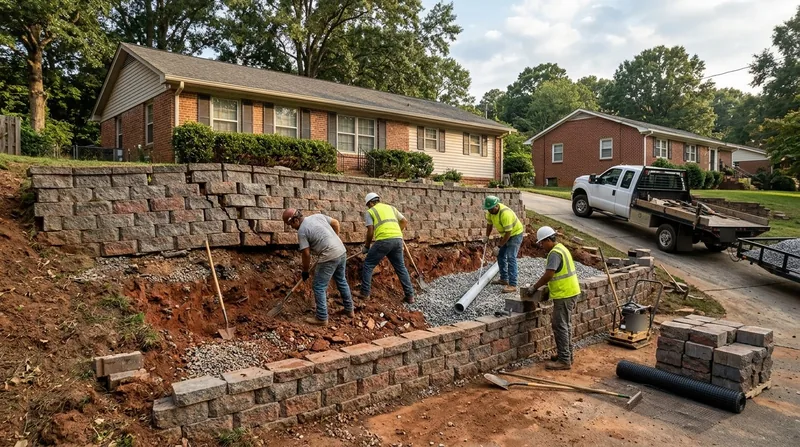




Charlotte's rolling terrain and sticky red clay create perfect conditions for retaining wall failure. Summer thunderstorms and tropical storms soak the ground, then drought cycles cause clay to shrink, leaving walls without support. When a wall leans, bulges, or collapses, the damage accelerates fast. Leaning & collapsed wall repair in Charlotte demands immediate attention, structural assessment, and a clear plan to stop further movement before the entire structure fails. We respond to emergency calls the same day, stabilize failing walls with tieback anchors and drainage correction, and rebuild when repair is no longer safe. The neighborhoods that suffer most are the 1980s and 1990s subdivisions with rotting landscape timber and railroad tie walls, the newer cut-and-fill developments from Ballantyne to Lake Norman shoreline with tall segmental block walls, and the older Dilworth, Plaza Midwood, Myers Park, and Eastover properties where brick and fieldstone garden walls have settled unevenly on clay. Our team knows the soil, the climate patterns, and the building code thresholds that trigger permit requirements in Charlotte and the surrounding areas.
Why Leaning and Collapsed Walls Are Urgent in Charlotte's Clay-Based Landscape
Charlotte sits on weathered saprolite and sticky red clay that behaves like a sponge during heavy rain and shrinks dramatically during dry spells. A retaining wall built without proper drainage behind it will fill with water during storms, creating hydrostatic pressure that pushes the wall outward and downward. Once a wall begins to lean, the pressure concentrates on the weakest point, and failure accelerates. A wall that leans 2 inches today can collapse in 6 months if the drainage problem is not fixed. Homeowners often wait because the wall "looks okay," but the internal damage is already happening. Delay turns a stabilization job into a full rebuild, which costs significantly more.
- Water trapped behind the wall creates hydrostatic pressure that pushes the structure outward and causes the characteristic lean.
- Clay shrinkage during drought cycles breaks the bond between the wall and its footing, allowing the wall to shift and tilt.
- Tieback anchors and soil nails stop the lean by anchoring the wall to stable soil deeper in the ground.
- Removing water with proper drainage and perforated pipe immediately reduces pressure and halts further movement.
- Partial rebuild or full replacement becomes necessary when the wall has moved more than 3 to 4 inches or shows structural cracks.
Early intervention saves money and prevents injury. A leaning wall can fail suddenly, especially after heavy rain or if someone leans against it or places weight on the soil above it.
Key info: Charlotte's building code requires a permit for retaining walls above 4 feet or when a wall supports a surcharge (driveway, structure, or fill). Always verify height limits and setback rules with the Charlotte Building Department or your local jurisdiction. Engineered drawings are required for walls taller than 6 feet or in tiered systems.
For more detail on what makes walls fail and how to prevent it, see our full retaining wall repair guide.
If you need guidance on permitting and regulations, contact the Charlotte Building Department at 311 or visit their website to verify requirements for your property.
How We Stabilize and Repair Leaning Walls in Charlotte
Our repair process starts with a detailed site visit to measure the lean, identify the water source, and probe the soil behind the wall. We photograph the damage, check for cracks, and look for signs of active movement. If the wall can be saved, we use tieback anchors or soil nails to lock it in place, then install or repair drainage to remove water pressure. If the wall has moved too far or shows structural failure, we recommend partial or full replacement. Every job is different, and the right approach depends on the wall's age, material, height, and how much it has moved.
- We assess the lean angle, soil stability, and water infiltration using visual inspection and hand probing to determine whether repair or replacement is feasible.
- We install tieback anchors by drilling horizontally through the wall into stable soil, then anchoring with epoxy and threaded rod to lock the wall in place.
- We cut drainage channels and install perforated pipe behind the wall to capture and direct water away from the structure, relieving hydrostatic pressure immediately.
- We backfill with compacted drainage stone and gravel to ensure water flows freely and does not pool against the wall face.
- We monitor the wall over the first month to confirm the lean has stopped and drainage is working before we consider the job complete.
For walls that cannot be safely stabilized, we provide a full rebuild estimate using the same material (block, concrete, timber, or stone) or recommend an upgraded system that will last longer.
Local example: A homeowner in Matthews noticed her segmental block wall leaning away from the slope after a week of heavy rain. We installed four tieback anchors spaced 8 feet apart, removed the saturated soil behind the wall, and installed 4-inch perforated pipe in a gravel trench. The wall stopped moving within 48 hours. Total cost was $4,200. Without intervention, the wall would have collapsed within six months, requiring a $12,000 full rebuild.
See our drainage and stabilization services for more technical detail on how we manage water and pressure.
Repair Methods and When to Use Each
| Approach | Description | Best For |
|---|---|---|
| Tieback anchors | Drill horizontally through the wall into stable soil 12 to 20 feet back, anchor with epoxy and threaded rod, then tension the rod to pull the wall back into plumb. | Walls leaning less than 4 inches, still structurally sound, on clay or rock with good bearing capacity 15+ feet deep. |
| Soil nails | Install 20 to 40-foot nails at downward angles through the wall into the soil mass, then grout and tension them to stabilize the slope and wall together. | Tall walls (6+ feet) or slopes with shallow rock layers, where tieback anchors cannot reach stable soil. |
| Drainage repair | Install perforated pipe and gravel behind the wall to capture and direct groundwater away, reducing hydrostatic pressure that causes lean. | Any leaning wall caused by water buildup; often used in combination with anchors for permanent results. |
| Partial rebuild | Remove the damaged section of wall, rebuild with new material and proper drainage, and tie the new section to the existing wall with rebar and mortar. | Walls with localized cracks or failure in one section, where the rest of the wall is sound. |
| Full replacement | Remove the entire wall, excavate and prepare the footing, rebuild to code with proper drainage, compaction, and backfill. | Walls that have moved more than 4 inches, show multiple cracks, or are unsafe to stabilize in place. |
Leaning & Collapsed Wall Repair Cost in Charlotte: What to Expect
The cost of leaning and collapsed wall repair in Charlotte depends on the wall's height, the extent of the lean, soil conditions, and whether you choose stabilization or replacement. Most tieback anchor stabilization jobs start at $2,500 for a small wall (under 4 feet) with one or two anchors and basic drainage work. A mid-sized wall (4 to 8 feet) with four to six anchors and full drainage replacement typically runs $4,500 to $7,500. Full replacement of a 6-foot segmental block wall can range from $8,000 to $15,000 depending on the length and whether the footing needs to be reset. Concrete and engineered walls cost more due to labor and material. Timber walls, which are common in the older subdivisions around Charlotte, often fail completely and require full replacement rather than repair, usually running $6,000 to $12,000 for a 20-foot section.
The main factors that affect your final cost are the wall's height and length, the number and depth of anchors needed, whether the footing is damaged or needs reset, soil conditions, and access for equipment. A wall on a steep slope with poor access costs more than one on level ground near a driveway. We always recommend getting 2 to 3 estimates so you can compare stabilization versus replacement options and understand what each contractor includes in their price.
For a detailed breakdown of typical costs and what influences them, visit our pricing page. We provide free estimates with no obligation, and we can discuss payment options for larger projects.
Leaning & Collapsed Wall Repair Near Me: What Charlotte Homeowners Should Know When Hiring
Finding the right contractor for leaning and collapsed wall repair near Charlotte means checking credentials, understanding what is included in the estimate, and making sure the contractor has handled similar jobs in your neighborhood. Start by verifying that any contractor you call is licensed and insured in North Carolina. Ask for proof of workers compensation and general liability insurance covering retaining wall work. Request references from at least two jobs completed in the past year, and contact those homeowners to ask about the quality of work and whether the contractor was responsive if issues came up after the job.
Before you hire, understand the permit requirements for your property. Many jurisdictions in the Charlotte area require a permit for walls above 4 feet or when a wall supports a surcharge. Your contractor should be willing to handle permit applications or coordinate with a licensed engineer if engineered drawings are required. Ask whether the estimate includes drainage work, because a repair without drainage often fails again within a few years. Confirm that the contractor will compact soil in lifts behind the wall and will not simply backfill loosely. If your property is in an HOA, check the design guidelines before you start. Some HOAs have restrictions on wall materials or height, and you may need approval before work begins.
Get the estimate in writing, with a detailed scope of work, timeline, and payment schedule. Do not hire based on price alone. The cheapest estimate often cuts corners on drainage or anchor installation, and you will pay for it when the wall fails again. A quality contractor will explain why they recommend a particular approach and will stand behind their work with a warranty.
Ready to move forward? Contact us for a free estimate. We will visit your property, assess the damage, and provide a detailed plan and price with no obligation. Call (980) 414-6473 if you need emergency service today.
Leaning & Collapsed Wall Repair in Charlotte: Pricing Guide
| Service | Price | Details |
|---|---|---|
| Tieback anchor stabilization (small wall) | Starting at $2,500 | One to two anchors on walls under 4 feet, basic drainage work, and one month monitoring included |
| Tieback anchor stabilization (mid-size wall) | Starting at $4,500 | Four to six anchors on walls 4 to 8 feet tall, full drainage replacement, and soil compaction included |
| Full wall replacement | Starting at $8,000 | Complete removal and rebuild of 6-foot segmental block wall up to 20 feet long with new footing and drainage |
| Engineered or complex job | On estimate | Tall walls, soil nails, engineered drawings, or structural concerns require site assessment and engineering review |
| Free estimate | No cost | Response within 24 hours, site visit, damage assessment, and written repair plan with no obligation to book |
Indicative pricing, the exact cost depends on square footage, finish, and site access. Free personalized estimate within 24h at (980) 414-6473.


