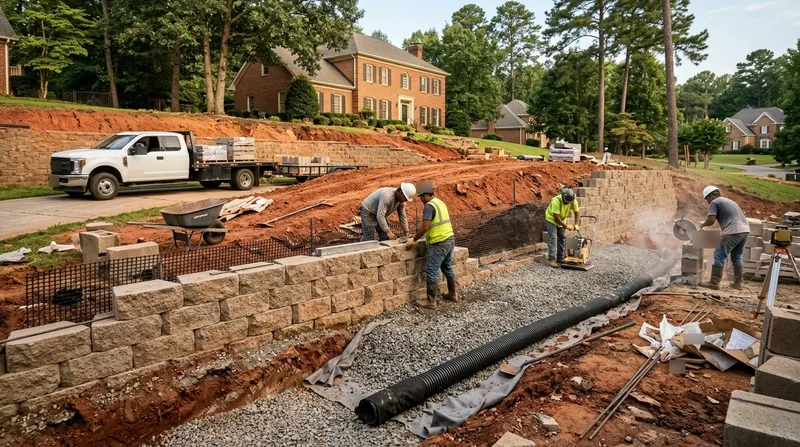




Retaining Wall Installation in Charlotte demands a deep understanding of red clay soils, summer thunderstorms, and the particular slope challenges that define this region. Charlotte sits on rolling upland terrain of sticky red clay over weathered saprolite, cut through by creek valleys like Sugar, Briar, and McAlpine Creek. From the brick Colonial Revival homes in Myers Park and Eastover with their fieldstone garden walls, to the postwar ranches spreading east and west, to the newer cut-and-fill neighborhoods along Ballantyne and Lake Norman, every slope tells a story of soil movement and water pressure. Red clay absorbs massive volumes of rain during summer storms and tropical systems, then shrinks dramatically in drought, pushing walls out of line and causing catastrophic failure if drainage and footings are not engineered correctly. We install new retaining walls that hold. This page covers how we design and build walls that stop clay movement, manage water, and last.
Why Red Clay Retaining Walls Fail in Charlotte, and How Proper Installation Prevents It
Charlotte's sticky red clay is the dominant cause of retaining wall failure across the city. When summer thunderstorms and tropical rain soak the clay behind a wall with no drainage, hydrostatic pressure builds and pushes the wall forward. Then drought shrinks the clay, creating voids and further instability. Walls installed without proper gravel backfill, perforated drainage pipe, and deep footings below the frost line fail within 5 to 10 years. We build walls that manage water from day one, so clay stays stable and walls stay plumb.
- We install gravel backfill behind every wall to allow water to drain freely, not pool and create pressure.
- We run perforated drainage pipe at the base of the wall, sloped to daylight or a swale, so water never saturates the clay.
- We dig footings below the frost line, typically 3 to 4 feet deep in the Charlotte area, so freeze-thaw cycles do not heave the wall.
- We compact soil properly before the footing to ensure stable bearing and prevent settlement.
- We slope the wall face slightly back into the hill, a technique called batter, so gravity and friction resist clay pressure.
These five practices are the difference between a wall that lasts 50 years and one that fails in a decade.
Key info: A 4-foot segmental block wall in Dilworth or Plaza Midwood installed without drainage will often lean or bow within 8 years. The same wall, built with proper gravel backfill and drainage pipe, performs reliably for 40 years or more. Water management is not an upgrade, it is the foundation of the job.
For more detail on how walls fail and how to repair them, see our Leaning and Collapsed Wall Repair page.
How We Install Retaining Walls in Charlotte: Step-by-Step Process
A properly installed retaining wall is built from the ground up, with every step done in the correct order and with the correct materials. We start with a site visit to understand the slope, the soil, the water flow, and any utilities or property lines. We then clear and excavate the footing trench, set the base course with proper compaction, install drainage infrastructure, and build the wall face to the required height and batter. The entire process takes 3 to 7 days depending on wall length and height, and the wall is ready for finishing (topsoil, plantings, or hardscape) within a week.
- Site assessment and layout: We mark the wall line, check for utilities, measure the slope, and identify soil type and drainage patterns.
- Footing excavation and preparation: We dig the footing trench to the required depth (typically 3 to 4 feet in Charlotte) and compact the base soil to bearing capacity.
- Base course installation: We set the first course of block or stone with proper level and batter, using concrete or mortar as specified by design.
- Drainage installation: We lay perforated drainage pipe at the base, wrapped in landscape fabric, and slope it to daylight or a collection point.
- Gravel backfill: We fill behind the wall with clean gravel in 6-inch lifts, compacting each lift to eliminate voids and ensure water flows freely.
- Upper wall courses: We build the remaining courses with consistent batter, checking level and alignment as we go.
- Finish topsoil and landscaping: We grade the top of the wall, install topsoil, and prepare the site for plantings or hardscape.
This methodical approach ensures the wall is structurally sound, well-drained, and ready to handle Charlotte's clay and weather for decades.
Local example: A homeowner in Eastover wanted to terrace a steep backyard for a patio and garden beds. The slope was 8 feet over 20 feet horizontal, all red clay. We installed a tiered wall system: a 5-foot base wall with proper footing and drainage, then a 3-foot upper wall set back 2 feet, creating a stable, level terrace. The job took 5 days and cost $4,200. The wall is now 3 years old and shows no movement or settling.
For detailed information on material options, visit our pages on Concrete Retaining Walls and Block and Segmental Retaining Walls.
Retaining Wall Installation Methods: Which Approach Works Best for Your Charlotte Yard
Different slopes, soils, and aesthetic goals call for different wall types. We build segmental block walls, poured concrete walls, natural stone and boulder walls, and timber walls, each with distinct advantages in Charlotte's clay and humid climate. The table below outlines the most common approaches and when each is best suited to the job.
| Approach | Description | Best for |
|---|---|---|
| Segmental Block (SRW) | Interlocking concrete blocks stacked with batter and connected with pins or adhesive. Flexible, modular, fast to install. | Residential yards, terraces, driveway cuts, walls 4 to 12 feet tall. Most common in Charlotte subdivisions. |
| Poured Concrete | Monolithic concrete wall cast on-site with reinforcing steel. Very strong, long-lasting, can be finished smooth or textured. | Tall walls (8+ feet), driveway supports, pools, commercial properties. Where maximum strength is required. |
| Natural Stone and Boulder | Fieldstone or boulders laid dry or with mortar. Aesthetic, blends with landscape, very durable in Charlotte clay. | Myers Park, Eastover, and other historic neighborhoods. Lower walls (3 to 5 feet), gardens, accent features. |
| Timber (Pressure-Treated or Composite) | Pressure-treated lumber or composite boards set on a concrete footing. Warm appearance, lower cost upfront, requires maintenance. | Small terraces, raised beds, landscape accents. Not recommended for tall or load-bearing applications in Charlotte. |
Each material performs differently under Charlotte's red clay pressure and humid climate. Segmental block and poured concrete are the most durable long-term choices. We help you choose based on your slope, budget, aesthetic preference, and the specific soil and drainage conditions on your property.
Retaining Wall Installation Cost in Charlotte: What to Expect
Retaining wall installation costs in Charlotte typically start at $30 per square foot for a basic segmental block wall with proper footing and drainage on a straightforward site. A 50-foot wall 4 feet tall would be roughly 200 square feet and cost around $6,000 to $8,000. Poured concrete walls run higher, typically $40 to $60 per square foot. Natural stone and boulder walls vary widely depending on stone availability and size. Timber walls are the least expensive upfront, starting at $20 per square foot, but often need replacement or heavy repair within 10 to 15 years in Charlotte's humid climate.
Several factors move the price up or down from that baseline:
- Wall height and length: Taller walls and longer runs increase material and labor cost proportionally.
- Site access and slope: Steep, overgrown, or hard-to-reach sites require more labor and equipment time.
- Soil conditions and excavation: Rocky soil or poor drainage may require deeper footings or additional site prep.
- Permits and engineering: Walls above 4 feet or supporting a surcharge (driveway, structure) often need engineered drawings and permits, adding $500 to $2,000.
- Material choice and finish: Natural stone and custom finishes cost more than standard segmental block.
The best way to know your actual cost is to get 2 to 3 estimates from licensed contractors who will visit your site, understand your soil and drainage, and give you a detailed scope and price. We offer free estimates within 24 hours. Visit our full pricing page for more detail on what drives cost in different scenarios, and call us at (980) 414-6473 to schedule a site visit.
Keep in mind that the cheapest estimate is not always the best value. A wall built without proper drainage and footings will fail early and cost you far more in repair or replacement. We price our work to include the materials and methods that make a wall last 40 to 50 years in Charlotte's red clay.
Retaining Wall Installation Near Me: What Charlotte Homeowners Should Know When Hiring a Contractor
Hiring the right contractor for retaining wall installation is one of the most important decisions you will make for your property. A poorly installed wall fails fast, and failure is expensive and dangerous. Before you sign a contract, verify that your contractor is licensed, insured, and knowledgeable about Charlotte's red clay and permit requirements. Ask for references from recent jobs in your neighborhood, and do not hesitate to call those homeowners directly. Understand what permits are required for your wall height and location, and confirm your contractor will handle the permit process or at least explain the requirements to you.
- Check licensing and insurance: Verify your contractor is licensed by the North Carolina Licensing Board for General Contractors and carries general liability and workers compensation insurance. Ask for a certificate of insurance.
- Ask for local references: Request contact information for at least 3 recent jobs in Charlotte, Concord, Gastonia, or nearby areas, and call those homeowners to ask about quality, timeline, and customer service.
- Understand permit requirements: Confirm whether your wall needs a permit from your city or county building department. Many jurisdictions require permits for walls above 4 feet or walls that support a surcharge like a driveway. Your contractor should know the local rules.
- Get multiple written estimates: Do not rely on a phone quote. Get at least 2 to 3 detailed estimates on paper that specify wall height, length, materials, footing depth, drainage, and site preparation. Compare the scope, not just the price.
- Verify HOA and setback requirements: If you live in a neighborhood with an HOA or have strict setback rules, confirm your contractor understands those restrictions and has a plan to comply.
- Discuss warranty and aftercare: Ask what warranty the contractor offers on the wall, and whether they provide any maintenance or inspection services in the first year.
A reputable contractor will answer all these questions clearly and provide documentation. If a contractor is evasive about licensing, insurance, or permits, move on to the next estimate.
For more information on how to choose a contractor and what to expect from the installation process, contact us for a free consultation.
Additional resources: The North Carolina Licensing Board for General Contractors maintains a public database of licensed contractors at nclaticore.gov. Many Charlotte neighborhoods also have city or county building department websites that outline local permit thresholds and setback rules. We recommend verifying requirements with your local building department before you finalize your design.
Retaining Wall Installation in Charlotte: Pricing Guide
| Service | Price | Details |
|---|---|---|
| Segmental Block Wall (Standard) | Starting at $30/sq ft | Includes footing, drainage pipe, gravel backfill, proper compaction, and labor for a straightforward site with good access |
| Poured Concrete Wall | Starting at $45/sq ft | Reinforced concrete, formwork, footing, drainage, and finishing; cost increases with wall height, complex shapes, or textured finishes |
| Natural Stone or Boulder Wall | Starting at $35/sq ft | Field stone or boulders, footing, drainage, and installation labor; final cost depends on stone size, availability, and aesthetic complexity |
| Permits and Engineering | Typically $500 to $2,000 | Required for walls above 4 feet or walls supporting a surcharge; cost varies by local jurisdiction and drawing complexity |
| Travel and Site Visit | Included | No separate mileage charge or travel fee for estimates and jobs within Charlotte and surrounding service areas |
| Free Estimate | No charge, no obligation | On-site consultation, soil assessment, and detailed written quote within 24 hours; call (980) 414-6473 to schedule |
Indicative pricing, the exact cost depends on square footage, finish, and site access. Free personalized estimate within 24h at (980) 414-6473.


