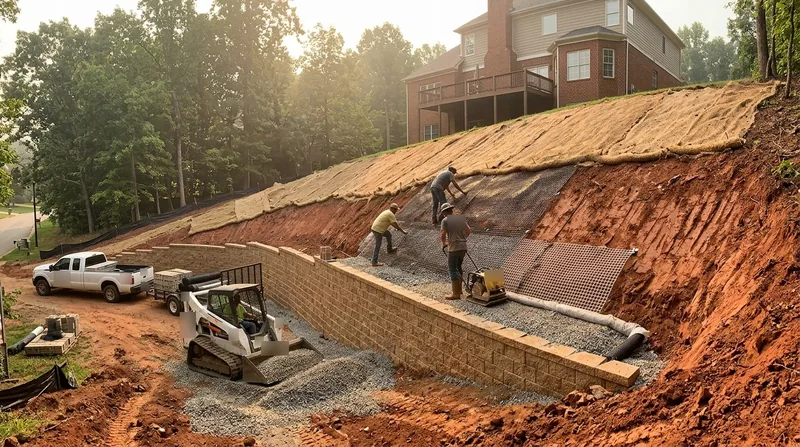




Slope stabilization and erosion control in Charlotte protects your home, driveway, and yard from the relentless forces of rain, clay shrinkage, and gravity that dominate this region's landscape. Charlotte sits on rolling upland terrain of sticky red clay over weathered saprolite, cut by creek valleys like Sugar Creek, Briar Creek, and McAlpine Creek. When summer thunderstorms and tropical systems drench these slopes, water saturates the clay; when drought follows, the soil shrinks and destabilizes. Retaining walls without proper drainage fail. Slopes slump. Driveways crack. Backyards slide downhill. We build terraced retaining wall systems with geogrid reinforcement and drainage to stop erosion before it damages your property. Our work spans neighborhoods from Dilworth's 1910s bungalows on gently sloped lots to Myers Park's brick Colonial homes with fieldstone gardens, from postwar ranches to 1980s subdivisions full of rotting timber walls, and from newer cut-and-fill neighborhoods in Ballantyne to the Lake Norman shoreline where tall segmental block walls anchor backyards. Call (980) 414-6473 for a free estimate, or learn more about our retaining wall installation services.
Why Slope Stabilization and Erosion Control Matters in Charlotte's Clay and Red-Dirt Neighborhoods
Charlotte's dominant soil type, sticky red clay over saprolite, is the enemy of stable slopes. This clay absorbs water like a sponge during heavy rain, then shrinks dramatically during dry spells. The result is settlement, cracking, and lateral movement that destabilizes anything built on or above the slope. Retaining walls without proper drainage are the first to fail, their backfill becoming saturated and pushing the wall outward. Erosion accelerates on unprotected slopes, washing topsoil away and undermining foundations, driveways, and landscaping. Terraced retaining walls with geogrid reinforcement and drainage systems stop this cycle by controlling water flow, distributing soil loads, and anchoring the slope mechanically.
- We install terraced retaining wall systems that distribute load across multiple walls rather than relying on a single tall wall prone to catastrophic failure.
- We embed geogrid reinforcement layers in the backfill to lock soil in place and increase the wall's resistance to lateral pressure from saturated clay.
- We run perforated drainage pipes behind walls and underneath slopes to intercept and direct water away from the soil mass, preventing the saturation that causes movement.
- We grade and slope the top of the slope away from structures to shed water and reduce infiltration into the soil mass.
- We stabilize exposed soil with erosion control blanket, native plantings, or sod to prevent surface runoff from carving gullies and destabilizing the slope face.
These methods work together to create a stable, long-lasting slope that handles Charlotte's wet summers and dry spells without shifting or eroding.
Key info: Homeowners in Mint Hill, Matthews, and Huntersville report the most slope failures during late summer and early fall, when clay-heavy soils have been saturated by weeks of thunderstorms and then begin to shrink as drought sets in. This is when cracks appear in driveways, walls lean, and erosion gullies cut deep into unprotected slopes.
For permit requirements and setback rules in your jurisdiction, consult the Mecklenburg County Land Use Services Department, as thresholds for engineered drawings and permits vary by city and district.
How We Stabilize Slopes and Control Erosion in Charlotte: Our Process
Slope stabilization begins with a clear diagnosis of the problem. We walk the site, observe drainage patterns, look for signs of saturation or settlement, and identify the soil composition and slope angle. We measure the height and length of the slope, note any structures or utilities at risk, and assess access for equipment and material delivery. We then design a terraced system tailored to your lot, incorporating geogrid, drainage, and erosion control that fits your budget and the local building code. Once you approve the design and estimate, we schedule the work and execute it methodically: excavate and prepare the footing, install the first retaining wall, backfill with compacted soil and geogrid layers, run drainage pipes, install the second or third wall if terracing is needed, grade the top of the slope, and apply erosion control blanket or plantings to stabilize the surface.
- We inspect the site and existing conditions, including soil type, drainage, structures, and property lines, to inform our design.
- We obtain or verify permits with the local building department, as walls above roughly four feet or supporting a surcharge (driveway, deck, structure) often require engineered drawings.
- We excavate the footing trench to undisturbed soil or bedrock, ensuring a solid foundation that won't settle or shift.
- We build the first retaining wall using block, poured concrete, or stone, depending on the design and your aesthetic preference.
- We backfill behind the wall with compacted soil, installing geogrid layers every 12 to 18 inches to reinforce the soil mass and increase lateral stability.
- We install perforated drainage pipe at the base of the wall and run it to daylight or a drainage swale, allowing water to flow freely rather than pooling behind the wall.
- We grade the top of the slope to shed water away from structures and the wall, reducing infiltration and prolonging the life of the system.
- We apply erosion control blanket, seed, or plant native shrubs and groundcover to stabilize the slope face and prevent surface erosion.
This phased approach ensures that every component of the system works in concert to hold the slope stable and safe for years to come.
Example: A home in Eastover with a brick Colonial on a steep slope overlooking McAlpine Creek had a 15-foot slope of exposed red clay behind the house. Heavy rains in July caused the slope to slip 3 inches, cracking the foundation. We built two terraced segmental block walls with geogrid reinforcement and installed a perforated drainage system that intercepted seepage from the slope above. The homeowner also replaced rotting landscape timber with native shade plants to slow runoff. The slope has remained stable for three years, and the foundation has settled no further.
Learn more about our retaining wall drainage solutions to see how we manage water in your specific situation.
Slope Stabilization and Erosion Control Methods: Choosing the Right Approach
| Approach | Description | Best for |
|---|---|---|
| Single Terraced Wall with Geogrid | One segmental block or poured concrete wall, 4 to 8 feet tall, with geogrid layers embedded in compacted backfill behind the wall to anchor soil in place. | Moderate slopes (1.5:1 to 2:1 grade) where one wall can safely hold the soil and drainage is adequate. |
| Multi-Tiered Terraced Walls | Two, three, or more retaining walls stacked at intervals up the slope, each with geogrid and drainage, distributing the load and creating a benched landscape. | Steep slopes (1:1 or steeper) where a single tall wall would fail, or where you want usable flat space between walls for patios, gardens, or yard area. |
| Drainage Retrofit Behind Existing Walls | Installation of perforated drainage pipe at the base of an existing wall (or behind it if the wall can be accessed), with a gravel or crushed stone trench to intercept seepage and direct water away. | Existing walls that are leaning, cracking, or showing signs of water damage, where saturation is the root cause of failure. |
| Erosion Control Blanket and Native Plantings | Biodegradable or long-life erosion control netting pinned to the slope face, combined with native shrubs, grasses, and groundcover to stabilize exposed soil and reduce runoff velocity. | Gentle to moderate slopes where retaining walls are not needed, or as a complement to walls to protect the slope face and reduce water infiltration into the soil mass. |
| Slope Regrading and Swale Installation | Reshaping the slope to a gentler grade (typically 3:1 or flatter) to reduce the angle and lateral pressure, combined with a shallow swale to direct water runoff away from structures. | Properties with room to expand the footprint of the slope, where flattening is more cost-effective than building tall retaining walls. |
Slope Stabilization and Erosion Control Cost in Charlotte: What to Expect
The cost of slope stabilization and erosion control in Charlotte depends on the height and length of the slope, the number of terraced walls needed, the type of material (segmental block, poured concrete, stone, or timber), the complexity of the drainage system, and site access. A single terraced wall with geogrid and drainage on a moderate slope typically runs between $8,000 and $18,000, depending on wall height and linear footage. Multi-tiered systems or very tall slopes can cost $20,000 to $50,000 or more. Erosion control blanket and native plantings alone might be $2,000 to $6,000 for a substantial slope. We always start with a free estimate on site, where we assess the specific conditions and provide a detailed quote. Factors that increase cost include difficult access (narrow driveways, tight lots), removal of existing failed walls, poor soil conditions requiring deeper footings, proximity to utilities or structures, and local permit requirements for engineered drawings. We recommend getting two or three estimates to understand the scope and compare approaches. Visit our pricing page for more detail on typical costs and what drives variation.
Slope Stabilization and Erosion Control Near Me: What Charlotte Homeowners Should Know When Hiring a Contractor
Hiring the right contractor for slope stabilization and erosion control is critical because a poorly designed or built system will fail, often within a few years, leaving you with a much larger and more expensive problem. Start by verifying that the contractor is licensed and insured in North Carolina and carries general liability, workers compensation, and completed operations coverage. Ask for proof of license and a copy of the insurance certificate. Get at least two or three estimates from different contractors, and compare not just price but the design approach, the materials proposed, the warranty or guarantee offered, and the contractor's references. Call past clients and ask about the quality of work, whether the slope has remained stable, whether the contractor was responsive to questions during the project, and whether they would hire the same contractor again. Understand the permit process for your property, as walls above roughly four feet or supporting a surcharge (driveway, deck) often require a permit and engineered drawings from a professional engineer. Some HOAs in neighborhoods like Myers Park, Eastover, and Dilworth have design guidelines or approval requirements for retaining walls; confirm this before you start. Ask your contractor whether they handle permitting or whether you need to apply yourself. Finally, ask about the timeline, the crew size, whether they will protect your existing landscaping, and what happens if weather delays the project.
- Request written references from at least three recent projects in Charlotte or nearby communities, and call them to ask about quality, durability, and customer service.
- Ask whether the contractor obtains permits and handles coordination with the local building department, or whether you must apply independently.
- Confirm that the contractor understands Charlotte's soil conditions, drainage challenges, and seasonal failure modes, and that their design reflects that knowledge.
- Get the estimate in writing with a detailed scope of work, materials, timeline, and any warranty or performance guarantee.
- Check for HOA design guidelines or approval requirements in your neighborhood before signing a contract.
A licensed, insured contractor with local references and a clear, detailed estimate is your best protection against costly mistakes and future failure.
Contact us today for a free, no-obligation estimate. We serve Charlotte, Concord, Gastonia, Huntersville, Matthews, Mint Hill, Cornelius, Davidson, and surrounding areas. Call (980) 414-6473 or fill out our online form to schedule an inspection.
Slope Stabilization & Erosion Control in Charlotte: Pricing Guide
| Service | Price | Details |
|---|---|---|
| Free site inspection and estimate | Free | We assess slope height, length, soil condition, drainage, and site access to provide accurate pricing tailored to your property |
| Single terraced wall with geogrid and drainage | Starting at $8,000 | Segmental block or poured concrete wall, 4 to 8 feet tall, geogrid reinforcement, perforated drainage pipe, includes grading and erosion control |
| Multi-tiered terraced systems or tall slopes | Starting at $20,000 | Two or more walls, steeper grades, complex drainage, engineered drawings, site-specific challenges like poor soil or tight access increase cost significantly |
| Erosion control blanket and native plantings | Starting at $2,000 | Biodegradable netting, native shrubs, grasses, and groundcover for gentle slopes or as complement to retaining walls, reduces runoff and stabilizes surface |
| Drainage retrofit for existing failing walls | Starting at $3,500 | Perforated pipe installation, gravel trench, daylight outlet or swale, cost depends on wall accessibility and linear footage of drainage required |
| Travel and mobilization | Included | No separate mileage fee or travel charge for Charlotte and surrounding service areas; labor, equipment, and materials priced separately in estimate |
Indicative pricing, the exact cost depends on square footage, finish, and site access. Free personalized estimate within 24h at (980) 414-6473.


