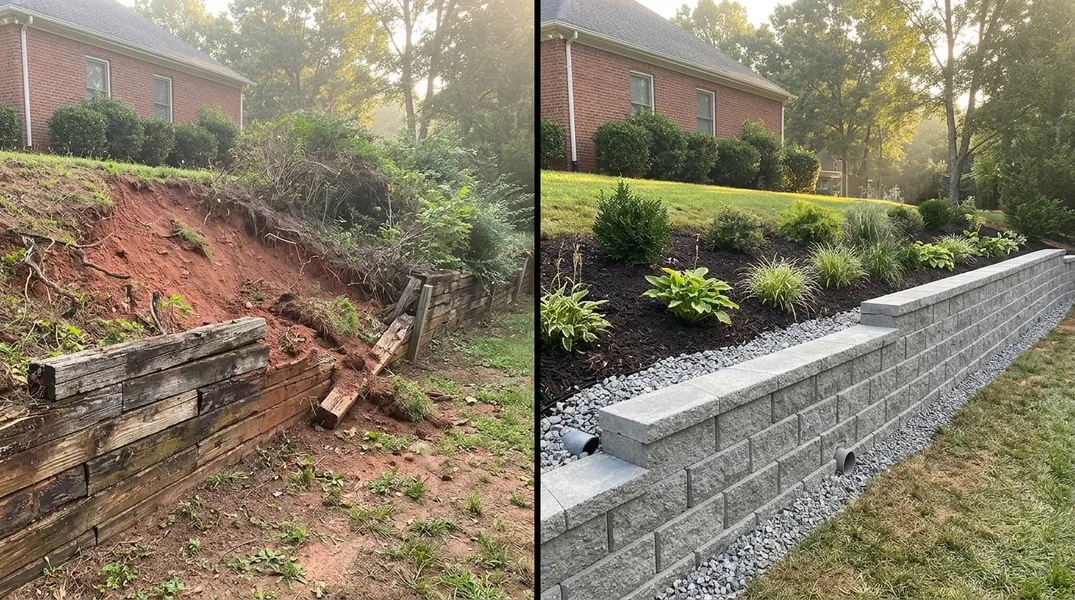
Understanding Red Clay and Its Impact on Retaining Walls
If you own property in Charlotte, you've likely noticed the distinctive reddish soil that defines the Piedmont region. This red clay is beautiful, but it presents a serious challenge for retaining wall longevity. Unlike sandy or well-draining soils, red clay holds moisture exceptionally well, expanding when wet and contracting when dry. This constant movement places enormous lateral pressure on retaining walls, which is why Retaining Wall Repair is one of the most common requests we receive from homeowners across the area.
The problem worsens during Charlotte's rainy seasons. When water saturates the clay behind a retaining wall, hydrostatic pressure builds up dramatically. This pressure pushes horizontally against the wall structure with tremendous force. Over time, even a well-built wall can begin to fail if it wasn't designed or installed with proper drainage and reinforcement to handle clay soil conditions. Understanding this geological reality is the first step in protecting your investment and maintaining safe property boundaries.
The Three Most Common Retaining Wall Failures in Clay Soil
A failing retaining wall typically exhibits one of three distinct failure modes in clay-heavy environments. The first is outward bowing, where the wall face curves away from the retained soil. This happens when hydrostatic pressure overcomes the wall's structural capacity. The second is horizontal cracking, which often appears in the middle sections of the wall as the structure tries to flex under stress. The third is foundation settlement, where the base of the wall sinks unevenly, causing the entire structure to tilt or lean. Each of these failures indicates that the wall's internal reinforcement, drainage system, or foundation is compromised.
What makes these failures particularly insidious in clay soil is their speed of progression. A wall that looks stable one season can become dangerously unstable within months once the failure process begins. The clay's expansion and contraction cycles accelerate deterioration, especially if the wall lacks adequate drainage. This is why homeowners who notice even minor signs of distress should seek professional evaluation promptly. The longer a failing wall goes unaddressed, the more expensive and complex the eventual repair becomes.
Warning Signs Your Retaining Wall Is in Trouble
Early detection is crucial for preventing catastrophic retaining wall failure. The most obvious warning sign is a leaning retaining wall that tilts noticeably away from vertical. You can check this by standing back and observing the wall profile, or by using a level against the face. Another critical indicator is visible cracking, particularly horizontal or diagonal fractures that run across multiple blocks or sections. Vertical cracks are sometimes normal in concrete or stone, but horizontal cracks almost always signal structural distress from soil pressure.
Watch also for soil bulging or heaving at the base of the wall, which indicates that drainage is failing and water pressure is building. If you see water seeping from the wall face during or after rain, this is a direct sign that hydrostatic pressure is present. Additionally, notice if vegetation or landscaping near the wall is dying or struggling, as this often reflects waterlogging in the soil. Finally, listen to your neighbors and other property owners nearby. If their walls are failing, yours likely faces the same clay-related pressures. These warning signs should prompt you to contact a professional for evaluation rather than waiting for the problem to worsen.
Why Standard Drainage Solutions Often Fail in Charlotte Clay
Many homeowners assume that a simple gravel drainage layer behind a retaining wall will solve moisture problems. In sandy soils, this approach works reasonably well. However, red clay presents a unique challenge. Water moves through clay extremely slowly, so even with a gravel backfill, water accumulates behind the wall face instead of draining away. The clay itself acts as a moisture barrier, trapping water and creating sustained hydrostatic pressure. This is why properly installed perforated drain pipes with geotextile fabric are essential for Retaining Wall Installation in clay environments.
The drain pipe must be installed at the base of the wall, wrapped in filter fabric to prevent clay particles from clogging it, and directed to a proper outlet where water can flow away from the wall. Many older retaining walls in Charlotte lack this critical infrastructure, which is a primary reason they fail. Additionally, the wall itself must be built with adequate height and thickness to resist the lateral forces that clay soil generates. A wall that might work fine in other regions can be undersized for clay conditions. This is why working with contractors experienced in local soil conditions is so important for long-term durability.
Retaining Wall Repair vs. Replacement: When You Need What
When your retaining wall shows signs of failure, you may wonder whether Retaining Wall Repair is sufficient or if Retaining Wall Replacement is necessary. The answer depends on the extent of damage and the wall's original design. Minor cracks, slight bowing under one inch, and minor drainage issues can often be addressed through targeted repairs. These might include installing or improving drainage systems, adding internal reinforcement, or applying structural epoxy to crack areas. Repairs are typically faster and more affordable than full replacement.
However, if a wall is leaning more than one to two inches, has major horizontal cracking, or shows evidence of foundation failure, replacement is usually the better choice. A severely compromised wall cannot be reliably strengthened and may continue to deteriorate despite repair attempts. Additionally, if the original wall was poorly designed for clay soil conditions, replacing it with a properly engineered structure ensures decades of reliable performance. When you're unsure which approach makes sense, professional assessment is invaluable. Contact Charlotte Retaining Wall at (980) 414-6473 to schedule a free estimate and learn whether your wall can be salvaged or needs replacement.
Protecting Your Investment: Prevention and Maintenance
The best strategy for avoiding retaining wall failure is proper maintenance and preventive care. After installation, monitor your wall seasonally, especially during spring when Charlotte experiences heavy rainfall. Keep the area around your wall clear of debris that might block drainage outlets. Ensure that downspouts and surface water are directed away from the wall base rather than toward it. If you have landscaping or mulch against the wall, keep it at least six inches away from the base to allow air circulation and reduce moisture accumulation.
For Concrete Retaining Walls and other structures, periodic professional inspection every two to three years is wise, particularly if your wall is older or you've noticed any minor warning signs. A trained eye can spot developing problems before they become serious. If you're planning new Retaining Wall Installation, invest in proper engineering and drainage design from the start. The upfront cost of a well-designed wall is far less than the expense of major repairs or replacement down the line. Charlotte Retaining Wall brings decades of local experience to every project, ensuring your wall is built to withstand the unique demands of clay soil. Call (980) 414-6473 today to discuss your retaining wall needs and get expert guidance tailored to your property.
Looking for a professional retaining wall contractor in Charlotte? Charlotte Retaining Wall responds fast for all your retaining wall needs.
Get a Free QuoteOur services: Retaining Wall Installation · Retaining Wall Repair · Retaining Wall Replacement